Audi Nearly Put A Twin-Turbocharged Diesel V12 In The R8
\
The Audi R8 brought back the philosophy of the daily driver supercar and is one of Audi’s most recognizable modern offerings and one of its most expensive models. The Audi R8 has morphed and changed throughout this lifetime, with its powertrain undergoing several changes over the decades.
2023 Audi R8 Coupe
Base MSRP
$158,600
Engine
5.2L V10 Gas
Horsepower
562 hp
Fuel Economy
14/23 MPG
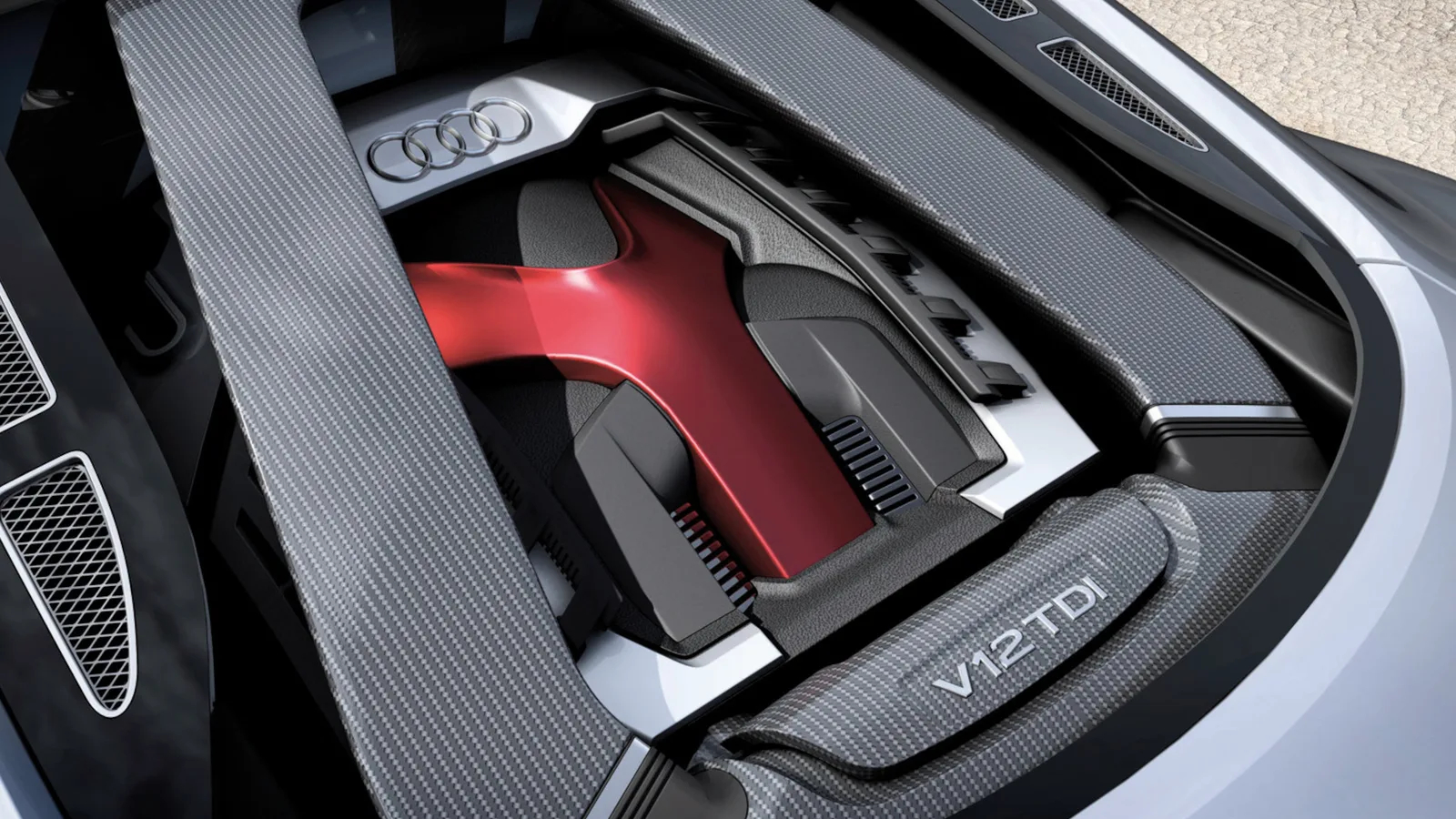
From a 4.2-liter V8 to a 5.2-liter V10 that carried the Audi R8 until its final days, the Audi R8 has never relied solely on a single engine. However, in the late 2000s, Audi toyed with the idea of putting a twin-turbo V12 engine in the Audi R8. The proof of concept was a model called the Audi R8 TDI Le Mans, and it envisioned a crazy German supercar.
This article focuses on the 2008 Audi R8 TDI Le Mans concept, which never reached production. A development of its engine did find a home in a very rare production Audi though – the first-generation Q7 V12 TDI.
The Audi R8 TDI Le Mans Concept
Audi introduced the Auri R8 to the world in 2003 at the International Geneva Motor Show and the Frankfurt International Motor Show, with the road car debuting in 2006. It marked the start of a model that would significantly impact the automotive industry by showcasing that a supercar can offer superb performance, yet be easy to live with. Only two years after the official debut of the R8 production series, Audi unveiled a radical concept car based on the R8. In fact, it was marketed as an Audi R8; the biggest difference between it and the production series model was the hulking 6.0-liter twin-turbocharged V12 engine that powered its four wheels.
That’s not really that strange considering Audi played around with a lot of ideas for the Audi R8, even toying with the idea of giving it a five-cylinder engine. It would have been the first high-performance supercar powered by a diesel engine, which was intended to slot in among Audi’s V engines at the time, culminating in the lineup of V6, V8, V10, and finally, a V12 engine. It leveraged Audi’s advanced Turbocharged Direct Injection (TDI) turbo-diesel technology and featured two turbochargers, each responsible for one cylinder bank. Interestingly, despite its crazy architecture, grin-inducing power outputs, and the fact that it was closely related to a racing engine that had helped garner a series of Le Mans wins, it still adhered to Euro 6 emissions standards.
Related
The Ultimate Audi R8 Send-Off Arrives In America With A Catch
Just 99 units have been made for the entire globe, and America is getting more than 10% of them.
The concept was adorned with the automaker’s Brilliant Red color scheme. Although clearly an Audi R8, the TDI Le Mans concept had a few defining visual elements that distinguished it from its road-going gasoline counterparts. This includes a different front fascia design with larger front air inlets underscored by an aluminum front lip, a new glass roof segmented by a NACA duct, larger side blades, and a redesigned glass lid showcasing the hulking turbo-diesel V12. It was an amazing concept, but how does this performance-focused Audi compare to the Audi R8?
How It Compared To The V10 Audi R8
Model
Audi R8 Le Mans concept
2010 Audi R8 5.2 V10 Quattro
Engine
6.0L twin-turbo turbo-diesel V12
5.2L NA gas V10
Horsepower
493 hp @ 4,000rpm
525 hp @ 8,000 rpm
Torque
740 lb-ft @ 1,500-3,000 rpm
391 lb-ft @ 6,500 rpm
0-60
4.2 seconds
3.8 seconds
Top speed
186 mph
196 mph
If we’re judging them by their powertrains, the Audi R8 V10 and the Audi R8 Le Mans were fundamentally different cars. One relied on a 5.2-liter, naturally aspirated V10 engine, which was based on the engine in the Lamborghini Gallardo (itself based on an engine used in other Audi models) and tuned to output more than 500 hp and work in collaboration with the quattro all-wheel-drive system to reach 60 mph from a standstill in less than four seconds. The other employed an engine based on an engine used in one of the automaker’s most memorable and potent race cars of all time and offered the juiced-up R8 with unbelievable torque figures and neck-straining launch from standstill.
Beyond powertrains, the Audi R8 TDI Le Mans utilized different suspension and braking systems to accommodate the added weight of roughly 661 lbs. Not only would the V12 TDI engine be more demanding on the chassis, suspension, and braking system, but it also demanded more from the cooling system, ergo the large NACA duct separating the glass roof, which was used to force more air into the engine. While the image of a rugged diesel engine might spring to mind, the 60-degree V12 was very refined.
Related
The Mid-Engined Audi That Brought Back The Daily Supercar Philosophy
The story of the Audi R8, and how it continued a legacy started by the Honda NSX.
Regarding horsepower output, the Audi R8 V10 wins and is one of the most powerful Audi models ever created. However, the opposite is true for torque output and by a significant margin. The twin-turbocharged diesel V12 engine offered the full weight of its 740 lb-ft of torque at just 1,500 rpm, and the twin-turbochargers played a huge role in that torque output because the turbos could generate 37 psi of boost. In contrast, the V10 R8 achieved full mast at 6,500 rpm, with its 525 hp delivered at 1,500 rpm later. Power delivery was set at low rpm, typical of a diesel engine, achieving the full power potential significantly earlier in the rev range. This, despite the considerable increase in weight, allowed the R8 TDI Le Mans concept to sprint to 60 in a touch over four seconds, which makes it one of the quickest Audi models.
Related
Why Diesel Will Survive In An EV-Dominated World
Electric vehicles may be gaining in sales, but diesel is far from done, thanks to heavy industry, market differences, and advances in tech.
However, the long V12 took up considerably more space, an obvious side effect of moving to the 6.0-liter V12 configuration. The rear bulkhead had been moved forward, diminishing the already scant space behind the Audi R8’s seats. Still, it would have been unreal to hear a twin-turbocharged 6.0-liter V12 TDI engine’s bassy thrum right behind the R8’s seats, considering how brutal the Audi R10 sounds, which, again, is powered by an engine closely related to the one used in the R8 TDI Le Mans concept. Unfortunately, the concept car would remain just that; a concept.
What Happened To The Audi R8 TDI Le Mans?
As with most concept cars that get our knees weak and palms sweaty but never make it to production, as with the Audi R8 TDI Le Mans, it is because of cost. Just a year after the TDI Le Mans concept was unveiled, Audi cancelled any plans to move the Audi R8 TDI Le Mans concept to production.
Related
Why The First-Generation Audi R8 V8 Is A Better Used Buy Than The V10
Audi’s first supercar came in two flavors; but while your head shouts for the V10 model, your heart (and wallet) loves the V8. Here’s why
According to Audi, the cost of developing and redesigning the Audi R8 to accommodate the twin-turbocharged V12 engine in the R8 would have been too costly, so much so that Audi claimed sales would not offset production and re-engineering costs. As such, the world would never see the Audi R8 TDI Le Mans concept brought to life and live alongside the gasoline-powered Audi R8 models, even though that would have been a sight to behold, much like the prices for the first-generation Audi R8 Spyder on the used market.
Interestingly, the twin-turbocharged V12 TDI was not put to rest alongside the Le Mans concept. Do you want to know what Audi did with the 6.0-liter power unit that made almost 500 hp in the concept car? They put it in an SUV. Specifically, the Audi Q7 resulted in the birth of one of the craziest SUVs ever, where the engine still made roughly 500 hp and propelled Audi’s SUV from a standstill to 62 mph in 5.5 seconds. That engine was also used in a crazy project where it found a new home in a Volkswagen Amarok.
Sources: Audi, NetCarShow
\