Bentley And Audi Also Built W16-Powered Hypercars
\
We all know the mighty Bugatti Veyron, poster boy of the Fastest Production Car title (even though it’s not) in any boy’s Top of the Trumps pack of cards. With its 6.0-liter W16 engine, it can rumble past a jaw-dropping 260 mph top speed seemingly without any effort.
But the Veyron wasn’t the first or only supercar with a W16 engine behind the driver’s back. Back in the day, the Volkswagen Group were poking around with concepts and marques to see which would become their flag bearer for superfast coupes, and which would settle into a more relaxed ambiance of grand tourers for the open road.
It’s a fascinating history, and largely forgotten, of how the maker of gentle people’s cars dabbled in the world of hyperfast (and very bonkers) sports cars.
This article focuses on the era at the Volkswagen Group that predates the birth of the legendary Bugatti Veyron. At the time, Audi was already part of the Volkswagen family, but Lamborghini and Bugatti were acquired only months earlier in 1998.
The VW Group’s Search For A Supercar
Specifications of the Bugatti Veyron
Engine
8.0-liter W16, turbocharged
Power
987 hp
Torque
922 lb-ft
Top speed
252 mph
How do you turn the maker of solid, family-friendly sedans and hatchbacks like the Golf, Beetle and Passat into a global powerhouse, with performance cars that can outrun (and outlast) even the wildest out there? Easy. You buy a couple of heritage brand names and set your engineers working.
In the late 1990s, Ferdinand Piëch, head of the Volkswagen Group, went on just such a buying spree across Europe, gobbling up an armful of exotic names like Bugatti, Bentley and Lamborghini, all within the space of a few months in 1998. But kudos to Piëch, it is one thing to buy a fancy but virtually defunct car brand. It is quite another to bolster it up with new models that would make the marquee the envy of everyone else.
Piech’s bold plan for VW
Piech wasn’t satisfied with Volkswagen being a manufacturer of only family cars and buses. He saw new things for the group, among which were supercars and luxury vehicles. Piech realized that not all of these could be branded under a VW banner (although he did try that with the disastrous VW Phaeton project). That’s why he acquired the Lamborghini, Bentley and Bugatti brands. Under these brands he could showcase Volkswagen’s engineering prowess – and sell more cars at ridiculous prices.
Looking back, it is interesting to see, though, that the VW Group was initially not really sure which brand would champion which function: should Bugatti be kept as a brand for luxury sedans, and Bentley for super sports cars? Or should it be the other way around?
When it came to engineering, though, the group seemed on a much stronger footing (maybe Piech’s background as an excellent engineer played a role here). The monstrous 8.0-liter W16 engine was developed by cobbling together two V8s, and first presented without any turbochargers in the Bentley Hunaudières concept car in 1999, and then with four turbochargers in the Veyron concept car in 2000.
Related
Bugatti Built A Bonkers Sedan In the Late 1990s
In the 90s, Bugatti unveiled two bonkers concept models powered by a W18 engine.
Bentley, the gentleman’s coupe
Looking at the sporty Bentley Hunaudières (1999) and Audi Rosemeyer (2000) concept cars, it seems as if VW AG first wanted Bentley to be the brand for fast coupes, while Bugatti (with the EB218 four-door concept car) would fly the flag for luxurious, but powerful, sedans.
We all know how that played out. Both Bentley and Bugatti had histories of racing cars, but for one reason or the other, the board in Wolfsburg decided that Bugatti would be the super-car brand going forward, while Bentley would be the gentleman’s coupe.
The Hunaudières and Rosemeyer – Precursors To The Veyron
Specifications of the Bentley Hunaudières
Engine
8.0-liter W16
Power
623 hp
Torque
561 lb-ft
Top speed
217 mph
Put the 1999 Geneva concept model of Bentley, the Hunaudières, side by side with the Bugatti Veyron, and the resemblance is uncanny. Andreas Mindt is credited with the design of the Bentley model, but five years later Hartmut Warkuss’ Bugatti Veyron had similar side scoops and a broad C-shaped accent line along the doors. Also, the convex shape, seen in profile, of the roofline and rear-end of the Veyron is all there, in essence, in the Hunaudières.
Bentley Hunaudières – the strangest name in concept history
According to some sources, the Hunaudières’ name pays homage to the famous straight of Le Mans (or the Circuit de la Sarthe, as it was formally known) where Sir Tim Birkin, in a Blower Bentley, overtook Rudolf Caracciola in a Mercedes SSK at 125 mph – with one side’s wheels on the grass – down the Hunaudières straight.
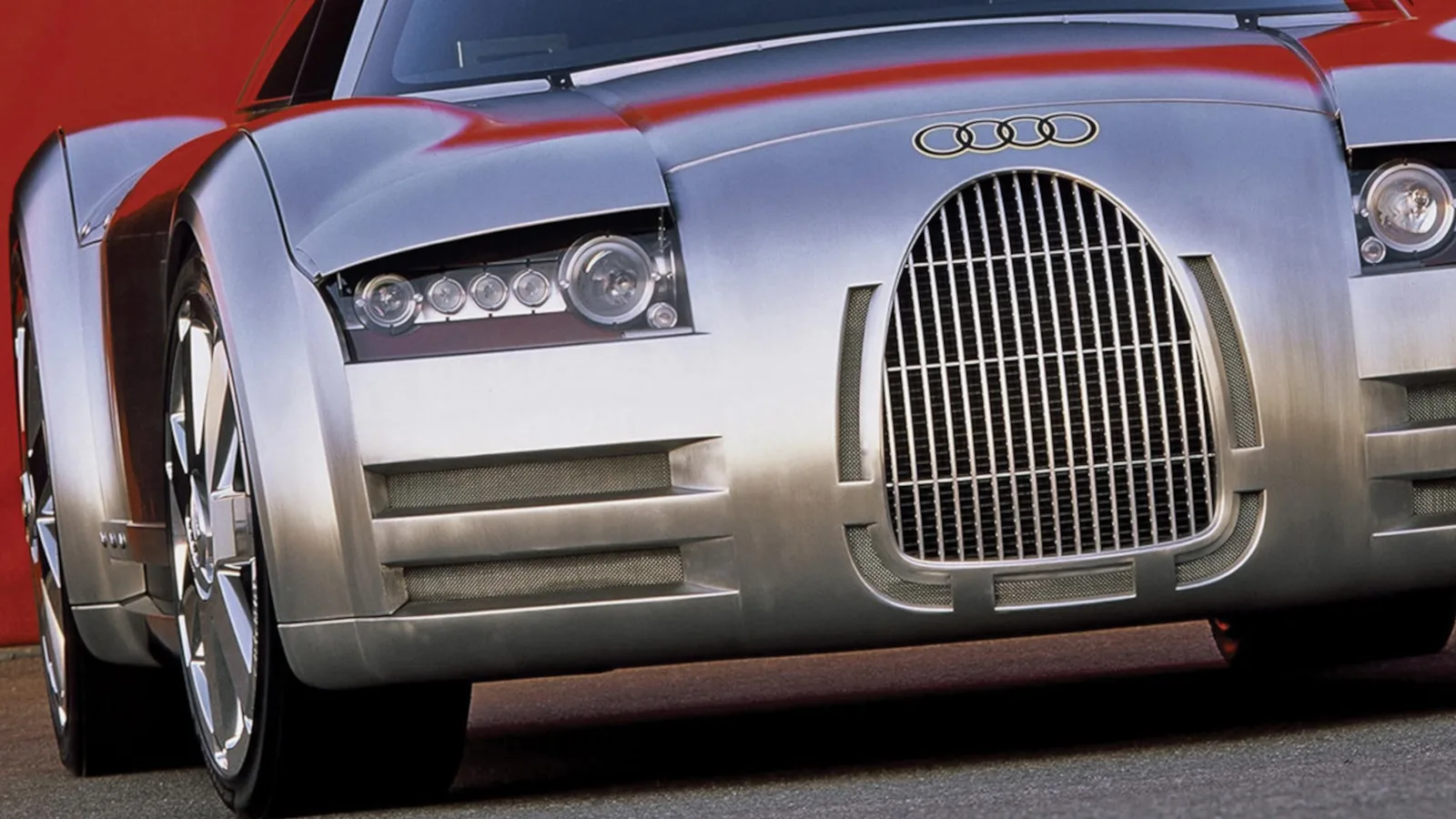
In a similar vein, Audi’s Rosemeyer concept car of 2000, a year after the Bentley debuted, had the same mid-mounted 8.0-liter W16 behind the passenger capsule. But as Audi progressed with its concept sports cars, from the Avus in 1999 to the Rosemeyer and then the Le Mans Quattro, they clearly veered more into the direction of the later Audi R8. A milder, sportier, and more square-looking sports car than the group sought with the route to the final production version of the Bugatti Veyron.
Related
The World’s First Last W16 Engines Are Headed To America
Bugatti’s record-setting roadster is leaving the production line, and the design decisions made by the owners are fantastic.
The mighty W16
Bugatti
But the star of both the Bentley Hunaudières and the Audi Rosemeyer was that mighty lump of steel and aluminum with its eight-liters of displacement, 16 cylinders, 64 valves and four turbos. The W16, a beast in naturally aspirated as well as turbocharged form.
Specifications of the Audi Rosemeyer
Engine
8.0-liter W16
Power
700 hp
Torque
560 lb-ft
Top speed
217 mph
In essence, it was two V8’s bolted together to honor that age-old American truth of « there’s no replacement for displacement ». In those early days, the engineers tinkered quite a bit with the engine. In the Hunaudières, it delivered 623 hp and 561 lb-ft of torque. A year later, in the Rosemeyer, it was still naturally aspirated, but power now jumped to 700 hp, with torque staying virtually the same at 560 lb-ft. In the Veyron, which debuted in 2005, four turbos were added which gave the Bugatti a staggering set of power figures (987 hp, 922 lb-ft).
But it all started with the obscure Bentley Hunaudières concept car, and a company that knew it wanted to build a new hypercar, but wasn’t sure which brand should take the reins.
Where do they fit in?
Looking back, we can see the multi-pathways the VW Group set out on in order to find its feet as stakeholder of various new brand names. With the acquisition of Lamborghini, things were easy. It was an established sports car brand. But Bugatti and Bentley posed new problems. Both were historical luxury brands, but with a strong racing heritage.
Where does the Rosemeyer name originate?
The Audi Rosemeyer was a stunning concept car which debuted at the Geneva Motor Show in 2000, featuring a polished aluminum body and deep grille inspired by the 1930s Auto Union race cars. It was named after one of that era’s ace drivers, Bernd Rosemeyer, who tragically died during a daring land speed record attempt on the new autobahn between Frankfurt and Darmstadt in Germany, in January 1938.
Related
Bugatti’s 247-MPH Wipeout Proves Why Top Speed Records Don’t Happen On Banked Ovals
Bugatti never spoke of this 247-mph crash, but the test driver did, and it teaches us a few lessons.
That’s why we first saw the Bugatti EB218 concept car, a luxury four-door sedan, followed some years later by the Veyron, a hypercar. The Hunaudières tried to push Bentley into the hypercar direction, but then Wolfsburg guided it into elegant, continental-crossing coupes. And Audi, well, tried its best to not upstage Lamborghini with its eventual sports car, the R8. But throughout the R8’s development history, from the Avus concept to the Rosemeyer, and then the Le Mans Quattro concept, Audi was clearly focused on one body shape and one type of sports car it wanted.
VW Group’s clever footwork with its brands
In the end, it is all about brand positioning. Which of the storied brand names should fulfill which role? All of which makes the Hunaudières and Rosemeyer such fascinating chapters in the Wolfsburg empire’s history.
Conclusion
Even if it was before the era of electrification, a monstrous 8.0-liter engine was still an anomaly in the motoring environment. Which made the Bentley Hunaudières and the Audi Rosemeyer even more of a specialty, as they were precursors to the marques’ later sports cars, the Continental GT and the R8.
Good timing by Audi and Bentley
But can we say that, as wonderful as a quad-turbocharged W16 sounds on paper, we’re happy that the eventual Continental GT and R8 had more ordinary engines than these pieces of engineering exotica. Like a good pacesetter, the Hunaudières and Rosemeyer paved the way for the Veyron, but left the track at just the right time.
Sources: Bentley, Volkswagen, Audi
\