Meet The Audi TT Rival The USA Missed Out On
\
There are many different breeds of two-door coupe available on the market, from performance-focused sports cars to luxury-geared cruisers like the Bentley Continental GT. There are also 2+2 coupes that straddle the line between the two, offering enough practicality to be useful every day but also enough pace and poise to thrill its driver when taken down a quiet back road. These kinds of cars also tend to be affordable, and come in the shape of cars like the Audi TT, which adds style to its list of talents.
2023 Audi TT Coupe
Base Trim Drivetrain
All-Wheel Drive
Base Trim Horsepower
228 hp
Base Trim Engine
2.0L Turbo Inline-4 Gas
Base Trim Transmission
7-Speed Automatic
Base Trim Torque
258 lb-ft @ 1600 rpm
Base Trim Curb Weight
3,197 lbs
Expand
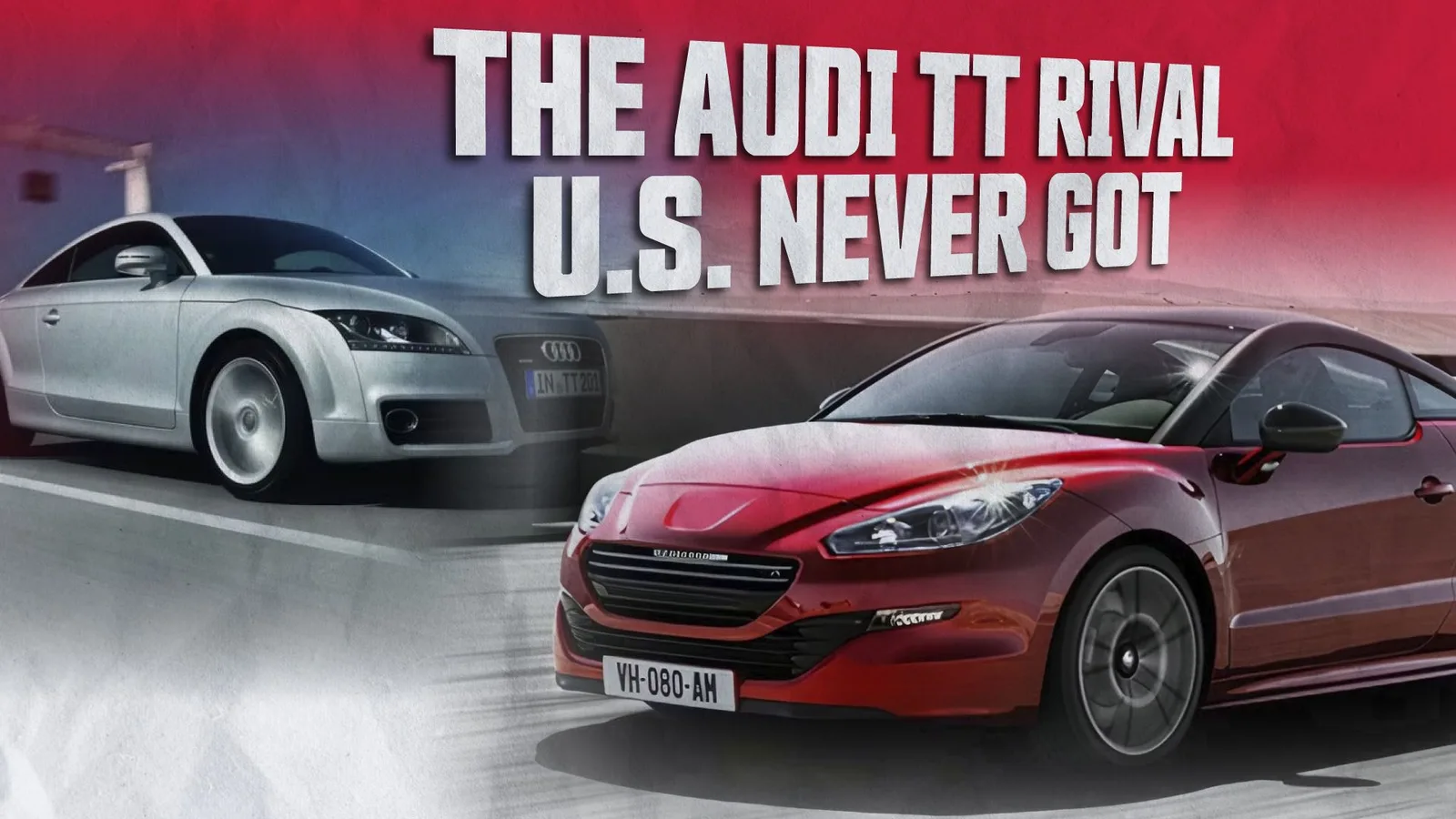
Wanting to take the fight to its German rival, Peugeot decided to cook up a 2+2 coupe contender of its own. Sadly, it never reached the US, meaning American gearheads never got to experience its engaging and thrilling handling.
This piece explores the Peugeot RCZ, and why it was such a compelling sports coupe.
Peugeot Took Its Time Getting The RCZ To Market
The French marque had floated the idea of offering a four-seat coupe to take on the likes of the TT, of which had few rivals due to its lower price point and list of boxes it ticked, a couple of years before it went on sale in 2009. Vehicles like the Toyota GT86 and the Porsche Cayman were aimed more at being focussed sports cars, rather than practical coupes like Peugeot was going for with the RCZ.
Related
The First-Gen Toyota 86 Is A Bargain, Especially If You Buy It With The Wrong Badge
Want a first-generation Toyota 86, but can’t dole out $20,000? Check out the Scion FR-S instead.
It was first shown as a concept at the 2007 Frankfurt Motor Show, where it gained notoriety for its strikingly sleek design, which was headlined by a prominent bubble roof that swept downwards towards the rear of the model. Its general design language was similar to that of the stunning TT, which wowed the automotive industry with its classic lines and Bauhaus style when it made its debut in the late 1990s.
The RCZ Never Made It To The US
As has been common for some time, Peugeot elected not to offer the RCZ for US audiences to compete against the TT. It instead staged its battle predominantly in Europe, with Peugeot looking to get ahead of Audi by pricing it significantly lower. The RCZ started from around $26,000 in the UK, for example, while the TT started at around $31,000. A big part of the reason was that not only was Audi seen as a more premium brand, but the cabins of its TTs were better put together than RCZs. That said, the RCZ gave the TT a run for its money in the driving department.
Discussion
What’s the most overrated sports car ever made?
Everybody loves a good debate, and no matter what anyone says about a car (or just about anything else), there’s somebody who vehemently believes in the polar opposite side of the opinion. With that in mind, what car makes your skin crawl when you hear somebody profess their love for it? For me, it’s the 8N Audi TT. If it wasn’t for the styling – and I love the styling – would it be remembered for anything else? As far as I’m concerned, it’s a two-door version of the most luxury-focused Golf until that point, it’s heavy, and it’s slow. It’s not very well-balanced, drinks fuel whether fitted with the GTI’s turbocharged four-cylinder or the R32’s narrow-angle V6, and sends most of its power to the front wheels most of the time. The TT had its little niche, but it’s not nearly as special as its fanatics suggest, and that’s why it doesn’t even exist anymore. I’m convinced of my opinion; what’s yours?
The RCZ Wasn’t Quite As Powerful As The TT
The RCZ was shipped with a similar technical configuration to entry-level Audi TTs, with its engine placed out front and sending its grunt to the front wheels. While the TT got a 2.0-liter inline-four engine that produced 211 hp, the RCZ came with a wider range of options. There were two different versions of the turbocharged 1.6-liter Prince I4 powerplant, which was developed in unison by Peugeot-Citroën and BMW and later used in the second generation of the Mini Cooper, with the less powerful version with 154 hp being included in the GT line. A more powerful 197-hp variant was available with the more expensive GT Line, while a more economical 160-hp 2.0-liter turbo-diesel unit was also on offer.
2009-2015 Peugeot RCZ Specifications
Engine
1.6L turbo I4 gas, 2.0L turbo-diesel I4
Power
154-197 hp
Torque
177-251 lb-ft
0-60 mph
7.3-8.0 seconds
Top Speed
133-146 mph
The diesel engine was fitted to the cheapest version of the RCZ, the Sport, and was twinned with a six-speed manual transmission, like the more powerful gas engines. A six-speed auto was available, though only with the 154-hp gas I4 unit. Its lack of grunt showed in terms of performance, with the 200-hp version getting to 60 mph in about 7.3 seconds, over a second adrift of the TT. The lack of pace is down to not only a relative lack of grunt, but also due to the RCZ weighing 80 pounds more.
The RCZ Brought The Magic In The Bends
Despite lacking outright speed, the RCZ makes up for it when things get twisty. Despite having a FWD-typical 64/36 weight distribution front to rear, the Peugeot engineers managed to make the RCZs nose stick, but also pointy enough so that you could easily get the nose into the apex. Its hydraulic power steering was also well-weighted, affording the driver enough feedback to point the wheels exactly where they want without being too heavy.
Related
Stellantis Makes A Big Decision About Its American Future
Stellantis wants to work on its existing brands in America, not make their slices of the automotive pie any smaller.
The RCZ’s MacPherson suspension setup was also tweaked to keep the vehicle stable over the kind of uneven roads commonly found in Europe, making it confidence-inspiring when attacking a corner, yet unperturbed by mid-corner bumps. Its handling is a breath of fresh air compared to other less engaging coupes on the market, making it an interesting alternative to the more established TT. The only justifiable black mark against the car was the rather unreliable Prince engine, which would develop an evil reputation for wearing out its cam chain, along with various other foibles.
Before we get too carried away, the RCZ isn’t exactly an MPV. While it has back seats, the low roofline, and cramped rear legroom mean that they’re only really usable by children. Still, what better than a backroad blast once you’ve dropped the kids off for the day? You can also enjoy the cabin, as Peugeot worked hard to make it feel more premium than the Peugeot 308 hatchback it was based on.
Related
Official: Peugeot’s American Dreams Are Dead
Long live Chrysler!
Higher-end trims came with black leather or Alcantara seats, with the leather chairs coming with electric adjustment and heating. All models came with rear parking sensors, dual-zone climate control, folding and heated mirrors, and a decent Peugeot sound system. Higher trims got extras like satellite navigation and front parking sensors. On the outside, all trims were graced with an active rear spoiler and twin-sports exhaust system, as well as a choice of 18 or 19-inch sports wheels.
Peugeot Came Up With A Special R Version To Wave Goodbye To Its Coupe
Due to slow sales, Peugeot eventually elected to cart the RCZ off to the retirement home in 2015. Before it went, Peugeot decided to develop a more hardcore performance version of the model. Dubbed the RCZ R, it was fitted with an upgraded version of the 1.6-liter Prince I4 that produced a front-tire scaring 266 hp. To prevent them from spinning up under the extra strain, a Torsen limited-slip differential was brought along to the party.
2014-2015 Peugeot RCZ R Specifications
Engine
1.6L turbo I4
Power
266 hp
Torque
243 lb-ft
0-60 mph
5.7 seconds
Top Speed
155 mph
These elements combined to allow the RCZ R to blast past the 60-mph barrier in about 5.7 seconds, very much in the same ballpark as the 2.0-liter TT equipped with Audi’s traction-boosting Quattro all-wheel-drive system. The standard RCZs suspension make-up was also stiffened up, by 14% at the front and 44% at the rear, to further reduce body roll and improve responsiveness, making it feel even more alive when winding through corners. A set of beefier 380 mm Alcon brakes were also added to the equation, making the RCZ quicker in every category compared to the standard car.
Related
What Every Brand Under The Stellantis Umbrella Is Supposed To Do
Since the merger of FiatChrysler with France’s Peugeot-led PSA group, a new conglomerate of brands have been established. We’ll dissect them for you.
It was also treated to a more aggressive fixed rear spoiler compared to the standard variant, as well as bespoke 19-inch wheels and a racier interior trim design. Just over 3,000 examples were produced between 2014 and 2015, making it a fine tribute to an underrated 2+2 coupe that combined style and substance as well as the better-known TT.
Sources: Peugeot, Audi.
\