The 2025 Audi S3 and Volkswagen Golf R Shift, Accelerate, Corner and Stop Faster Than Ever
\
Both the Audi S3 and Volkswagen Golf R feature enhanced performance, power, and handling for the 2025 model year, thanks in no small part to a powertrain and driveline update centered around the famous four-cylinder engine that powers them both. That engine is still the EA888, commonly referred to as the 2.0T or ‘two-liter turbo’. The Hungarian-built powerplant is one of the world’s most popular four-cylinder turbo engines, and recently entered its fourth generation on sale. Today, in 2025, it’s leaving the factory with more power than ever, and supporting upgrades to match.
0-60 MPH
4.4 seconds
Segment
Full-Size Luxury Sedan
Base Trim Engine
2.0L Turbo Inline-4 Gas
Base Trim Transmission
7-speed Dual-Clutch Automatic
Base Trim Drivetrain
All-Wheel Drive
Base Trim Horsepower
328 hp
Base Trim Torque
310 lb-ft
Dollar for dollar and pound for pound, these upgrades and tweaks will make both the latest Golf R and S3 even more appealing to shoppers keen to squeeze higher-than-ever levels of performance from their purchase (and fuel) dollars. Today, vehicles are changing before our eyes. Automakers around the globe are pushing into new and uncharted territories with new ideas and technologies, while some work to perfect existing recipes honed over generations. The two cars below are a great example of the latter.
We’re highlighting the recent technical and performance advancements applied to the 2025 Volkswagen Golf R and 2025 Audi S3, with all data sourced from the manufacturer.
Hardware Upgrades Galore For The EA888
2025 Volkswagen Golf R / Audi S3 Specifications
Engine
2.0L turbo I4
Horsepower
328 hp
Torque
295 lb-ft
Transmission
7-speed dual-clutch auto
0-60
4.7 sec (approx)
The EA888 engine has been through a multitude of upgrades and tweaks throughout its life. Various configurations of this engine have served duty under the hoods of Volkswagen and Audi models, from the Tiguan and Arteon to the Q5 and A4. The fourth-generation engine (aka Evo 4) was introduced in 2020, and for the 2025 model year, the latest round of tweaks have pushed the long-evolving four-cylinder into new performance and refinement territory, giving shoppers more value for their dollars along the way.
In both the S3 (pricing from the low sixties) and Golf R (high forties), look for 328 horsepower (an improvement of 13 hp for the R and 22 hp for the S3) and 295 lb-ft of torque on premium-grade fuel. The dual-cam engine now uses Volkswagen’s latest variable cam-phasing system to control both intake and exhaust valve timing, as well as variable lift on the exhaust valves. This gives the EA888 excellent control over its breathing in real time.
Related
13 Engines That Deserved To Stick Around For Longer
May they be remembered with appreciation, not sadness.
The exhaust headers are built directly into the cylinder head of the EA888 engine. This is a win-win situation that allows the exhaust manifolds to be liquid-cooled by the engine, which works to help keep the turbo system cooler. Also, the engine’s exhaust stream can be used to heat the engine up more quickly, which reduces emissions and improves fuel economy.
Fuel is delivered by the latest high-pressure direct-injection system, with injection pressure up by 75 percent versus the previous engine. Injectors blast fuel into the combustion chambers at 5,076 psi, ensuring rapid atomization and mixing. The high injection pressure also allows the injected fuel to absorb heat as it rapidly expands, effectively cooling the combustion chamber with every injection event.
New tuning allows the turbocharger to preload in certain situations. Now, the engine can keep its turbo spinning fast even when the throttle is applied lightly, or at the rev-limiter. This keeps boost pressure at the ready to the benefit of more direct throttle response, and makes the powertrain even more direct, efficient, and usable. Other tweaks to the engine for 2025 include an assault on unwanted friction between internal components, which Volkswagen says allows the latest EA888 to hold peak torque over a broader rev range, while also improving the engine’s acoustics.
1:01
Related
Video: VW Explains Why The GTI’s Interior Is Better Than The Golf R’s
It’s a bit of a weak excuse.
Still, we’re only part-way through the 2025 upgrades.
Nürburgring-Ready Traction Tech
A little while back, we told you about the Audi RS3 and how its trick rear differential helped it turn in a blistering Nürburgring lap time. The same torque-splitting tech introduced in the latest RS3 has now made its way downstream to the S3 and Golf R, both of which offer the high-tech new rear axle to help make the best possible use of their higher power outputs.
In the previous-generation Golf R, the 4Motion system could send up to 50% of the engine’s total power to the rear axle. Now, the system gains the ability to direct power across that rear axle once it arrives, for a further degree of control that unlocks some impressive capabilities. The new torque-splitter axle has two multi-plate clutches, one for each wheel. Each clutch is connected to a compact electric motor with a gear drive which controls the clamping force on each clutch, and therefore the driving force to each wheel. Up to 100% of the rear-wheel torque can be sent to an individual rear wheel in the blink of an eye.
Related
The 10 Fastest Manual Cars To Ever Lap The Nurburgring
It’s an evolutionary inevitability: racetracks love paddleshift gearboxes. But these 10 mavericks prove there’s still plenty of life in the manual yet
The system considers a real-time stream of data relating to speed, g-forces, steering angle, throttle position and more. For instance, when cornering on the throttle, more power can immediately be sent to the outer rear wheel, relative to the curve, which helps steer the vehicle. As quickly as the driver can steer the car, the rear axle can re-apportion the rear-axle torque split accordingly to support them, in real time. In addition, the AWD system also self-engages before wheelspin occurrs, and can decouple the rear wheels to save fuel, re-engaging them in milliseconds when required.
Related
2025 Audi RS3 Beats The M2 On The ‘Ring And On The Sticker
Audi’s awesome five-pot gets even better.
To summarize, power from the Golf R or S3’s engine is first split between the front and rear axles by a center differential with a computer-controlled clutch inside that’s activated by a fast-acting hydraulic pump. When the center differential powers the rear wheels, the two additional clutches in the rear axle come into play, each with its own screw-driven clutch controlling power flow to a single wheel. By controlling the flow of electricity to one hydraulic pump and a pair of motor-driven screw gears, the 2025 S3 and Golf R can optimize AWD power distribution on the fly.
They Shift and Stop Faster Too
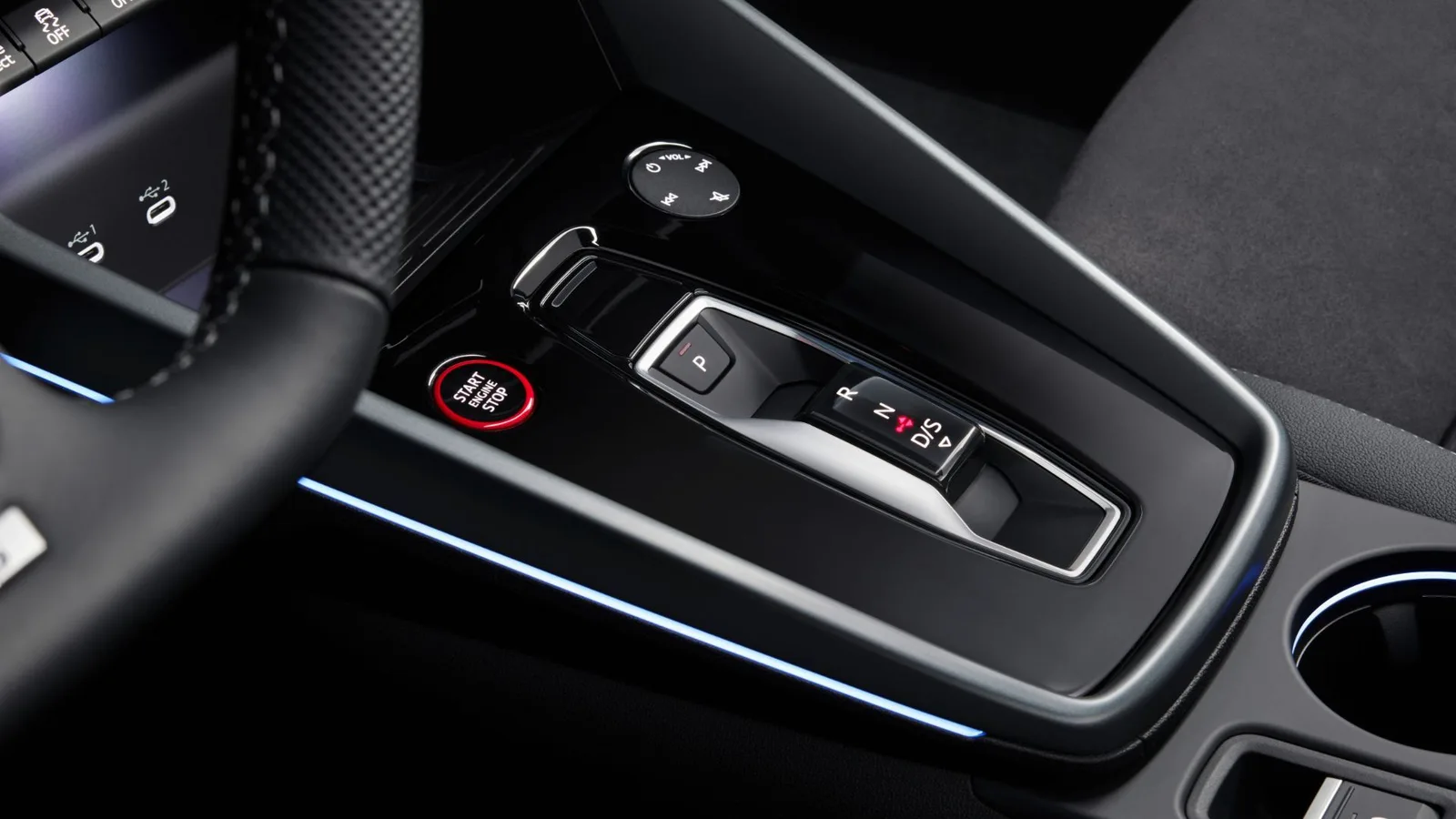
Both cars come standard solely with a seven-speed DSG dual-clutch automatic transmission with paddle shifters. This type of transmission changes gears much more quickly and smoothly than a conventional manual (and most automatics). Recent tweaks have improved performance, especially off the line. According to Audi, the transmission has been retuned for stronger starting torque and initial clutch pressure, which gets the car up to speed more quickly. A retuned shift program ensures the transmission works favorably with the revised engine’s new power curve, and under full throttle, upshift times have been cut in half.
Increased driving dynamics mean increased demand on the vehicle brakes, so both the S3 and Golf R get a new set of bigger brakes this year as well. It all adds up to elevate these two hot cars that share a powertrain to the head of their respective classes.
Sources: Audi, Volkswagen.
\