The Mid-Engined Audi That Brought Back The Daily Supercar Philosophy
\
The concept of the “daily supercar” is a fascinating one. For automotive enthusiasts who dream of joining the ranks of supercar owners, but don’t quite have the garage (or budget) to run both a daily driver and a track toy, a supercar that can be driven daily with ease offers the best of both worlds. Supercars are traditionally oriented towards performance and speed rather than comfort: from sports seats to track-ready suspension setups, there usually isn’t much about a supercar that screams “suburban commuter”. However, some automakers have bucked the trend, creating cars that feel equally at home carrying groceries or being driven in anger on a racetrack, such as the Porsche 911 Turbo and Audi R8.
2023 Audi R8 Coupe
Engine
5.2L V10 Gas
Horsepower
562 hp
Base MSRP
$158,600
Fuel Economy
14/23 MPG
While Honda’s NSX was one of the earliest pioneers of the daily supercar, the concept somewhat fell off the radar when its first generation went out of production in 2005. Two years later, however, another car worthy of the title emerged: the Audi R8, which combined performance to rival Lamborghinis (not a coincidence, given it shared a good portion of its DNA with the Gallardo) with road-trip levels of comfort and tech.
This article focuses on the Audi R8 and the concept of the « daily-driver supercar ». There are several examples of sports cars that are usable every day, but like-minded supercars are comparatively rare, which is why we concentrate on the R8’s particular blend of talents.
The First-Generation Audi R8
Engine
4.2L NA V8 | 5.2L NA V10
Horsepower
414-562 hp
Torque
317-398 lb-ft
0-60
3.2-4.8 seconds
Top Speed
186-199 mph
The first generation of the Audi R8 originates from a concept car introduced in 2003, called the Audi Le Mans Quattro, which already included many of the stylistic choices and features that would later end up in the R8. Work on the production model began the following year; the Type 42 (first generation) R8 was then introduced in 2006 at the Paris Motor Show, to be sold for the 2007 model year.
Design
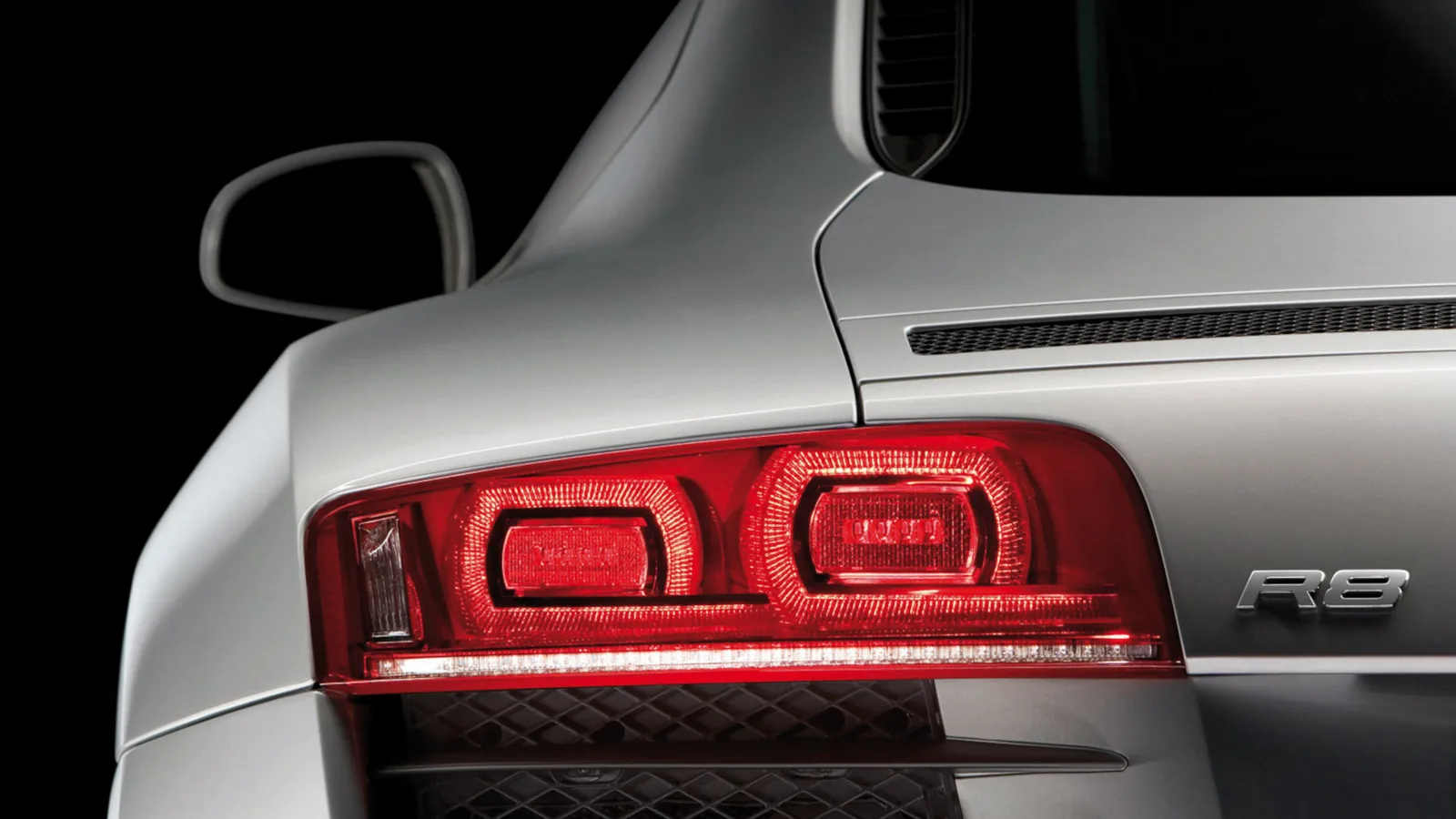
On the visual front, the Audi R8 echoed its character: incorporating elements of the supercar without being overly flashy or impractical, the R8 showcased its dual nature with its design. It was still instantly recognizable as an Audi, while introducing some exotic elements here and there that betrayed its Lamborghini DNA. Its sharp, narrow headlights and low, sleek profile made it clear that, while you might see an R8 happily handling a daily commute, it would be equally at ease being thrown around a track.
Related
How To Prepare Your Car For A Track Day
Everything you need to know.
Powertrain
The Type 42 Audi R8 was powered by two different naturally aspirated engines: a V8 and a V10. The 4.2-liter V8 was the first engine to be introduced, powering the R8 Coupe 4.2. Two years later the first V10-powered version was introduced: the Coupe 5.2. This 5.2-liter engine was based on the unit that powered the Lamborghini Gallardo. The R8 and Gallardo also shared a chassis, transmission, and several other components (such as door-handle mechanisms), to keep development costs down.
Personally, I love the R8 V8 more than the V10. I know that’s a controversial opinion, but you got the supercar looks, more than adequate performance, and the car was less loud. Plus, Audi’s V8 engine is one of the best ever made. I used the R8 V8 manual to take my wife to her first doctor’s appointment after we found out she was expecting our first child. That’s how user-friendly it is. Gerhard Horn – Senior Editor.
Interior And Tech
The first-gen R8 does not neglect the comfort of its occupants in favor of performance: the seats are sporty without being uncomfortable, and features like climate control and navigation are standard (in the case of navigation, standard only on all models after the 2012 facelift).
Related
Hydropneumatic And Magnetic Ride Suspensions Explained
Not all car suspensions are made the same.
It also had another high-tech feature that made it suitable for daily use: the innovative “magnetic ride” suspension, which allowed the driver to tighten the shock absorbers at the push of a button. This feature broadened the car’s range to include both high-performance driving and comfortable everyday driving.
The Second-Generation Audi R8
Development work for the second (Type 4S) generation of the Audi R8 began in 2013, as the lifespan of the first-gen model was drawing to a close. The switch-over happened two years later, after the new generation was introduced at the 2015 Geneva Motor Show.
Engine
5.2L NA V10
Horsepower
533-602 hp
Torque
369-413 lb-ft
0-60
3.0-3.7 seconds
Top Speed
186-205 mph
At the same event, Audi also introduced a short-lived electric version of the R8 called the R8 e-tron. The company’s original vision had been to develop it in conjunction with the first-gen model, and a handful of concepts and prototypes had already been completed, but by the time the R8 e-tron became a production model, plans had changed, and the car was now based on the Type 4S. The R8 e-tron was unsuccessful and eventually ended up being killed off in 2016 after less than a year.
Design
The Type 4S’s design did not make an overly radical change compared to the Type 42; it took most of the elements that had characterized the first-gen model and gave them an even sharper, more aggressive edge. The grille got a makeover, featuring a honeycomb pattern instead of the simple horizontal lines seen on the first generation. The “side blades” that, in the previous generation, were only present behind the doors could now be found on the side windows as well.
Related
The Final Audi R8 Supercar Has Been Produced At Last
The V10-powered supercar has finally reached its end after two generations.
Powertrain
The R8’s second generation dropped the V8 entirely, instead being powered by two different variants of the Lamborghini 5.2-liter V10. The first, seen in the 5.2 FSI model, produced 533 hp, while the more powerful variant seen in the V10 Plus model produced 602 hp. A 7-speed dual-clutch transmission completes the picture; in the R8, the quattro all-wheel-drive system has a slight bias towards the rear wheels, giving the car character without making it too unruly.
Interior And Tech
The second-gen R8 represented a considerable jump forward in terms of tech compared to the Type 4S. The Virtual Cockpit technology, which had first been made available in the TT, was introduced to the R8 with the arrival of the Type 4S; a number of different dashboard layouts are available, depending on the driver’s needs. 4G-enabled internet connectivity allows the car to receive weather and traffic data, stream music and keep mobile devices connected while on the move.
Before The Audi R8: The Honda NSX And The « Daily Supercar » Concept
While the Audi R8 became the rising star of daily-friendly supercars in the current millennium, the model that truly pioneered the concept was the Honda/Acura NSX back in 1991. At the time of the NSX’s launch, the idea of supercars that could also function as a comfortable, reliable and safe daily driver was not a popular concept in the automotive world. Honda, however, wanted to do something different.
Related
Honda Built The World’s First Daily Supercar
In the early 1990s, the manufacturer of some of the most dependable vehicles ever made decided to offer the first everyday supercar.
The earliest incarnation of what would become the NSX arrived in 1984, in the form of a futuristic concept car called the HP-X (Honda Pininfarina eXperimental). This concept included several features that would later become commonplace: these included a “central information display” equipped with a video screen and CD player, as well as GPS navigation.
The HP-X planted the seed for the idea of a supercar kitted out with creature comforts: although the production NSX didn’t quite have all the sci-fi features seen in the concept, it was still oriented towards keeping occupants comfortable in a way that other supercars of the time were not. Its mid-engined layout allowed for more storage space and legroom, while the seats were designed for both comfort and performance. Climate control and a Bose audio system were both standard features, operated through controls arranged with an intuitive, easy-to-use layout. It was a legitimate Ferrari 348 rival, but a lot easier to drive.
What Makes A Supercar Daily-Friendly?
The fundamental aspect of a “daily-driver supercar” is the balance of performance and comfort. What the Audi R8 and the Honda/Acura NSX, as well as other daily-friendly supercars like the Porsche 911 Turbo, have in common is the presence of features aimed at creating a more comfortable, safer driving experience without losing the car’s character.
Driver aids are a large part of this: devices such as traction control and stability control helped supercars go from borderline ungovernable speed demons to pleasant, safe cars that could be used for the daily commute. In more recent years, advanced driver assistance systems (ADAS), such as blind spot monitoring and automatic emergency braking, have entered the automotive world as well.
Related
The Technology That Turned Rabid Supercars Into Friendly Daily Drivers
Supercars no longer deserve the fearsome torture chamber labels they used to have. So just how have they gone from widowmakers to merrymakers?
Once the safety aspect is covered, practical features and tech are the other side of the equation: a supercar may be safe and comfortable to drive on the road, but without a good infotainment system and storage solutions (as much as one can have on a supercar, anyway) it will not be suitable as a daily driver.
Everyone has their own idea of what constitutes an acceptable level of comfort and tech for a car to be a good daily driver. However, the R8 was a particularly good example of a model that truly embodied the “daily supercar” concept, carrying forward a legacy that still continues in other models today.
Sources: Audi, Honda.
\