What I Learned Drifting Audi’s Most Powerful Car Ever With Zero Grip
\
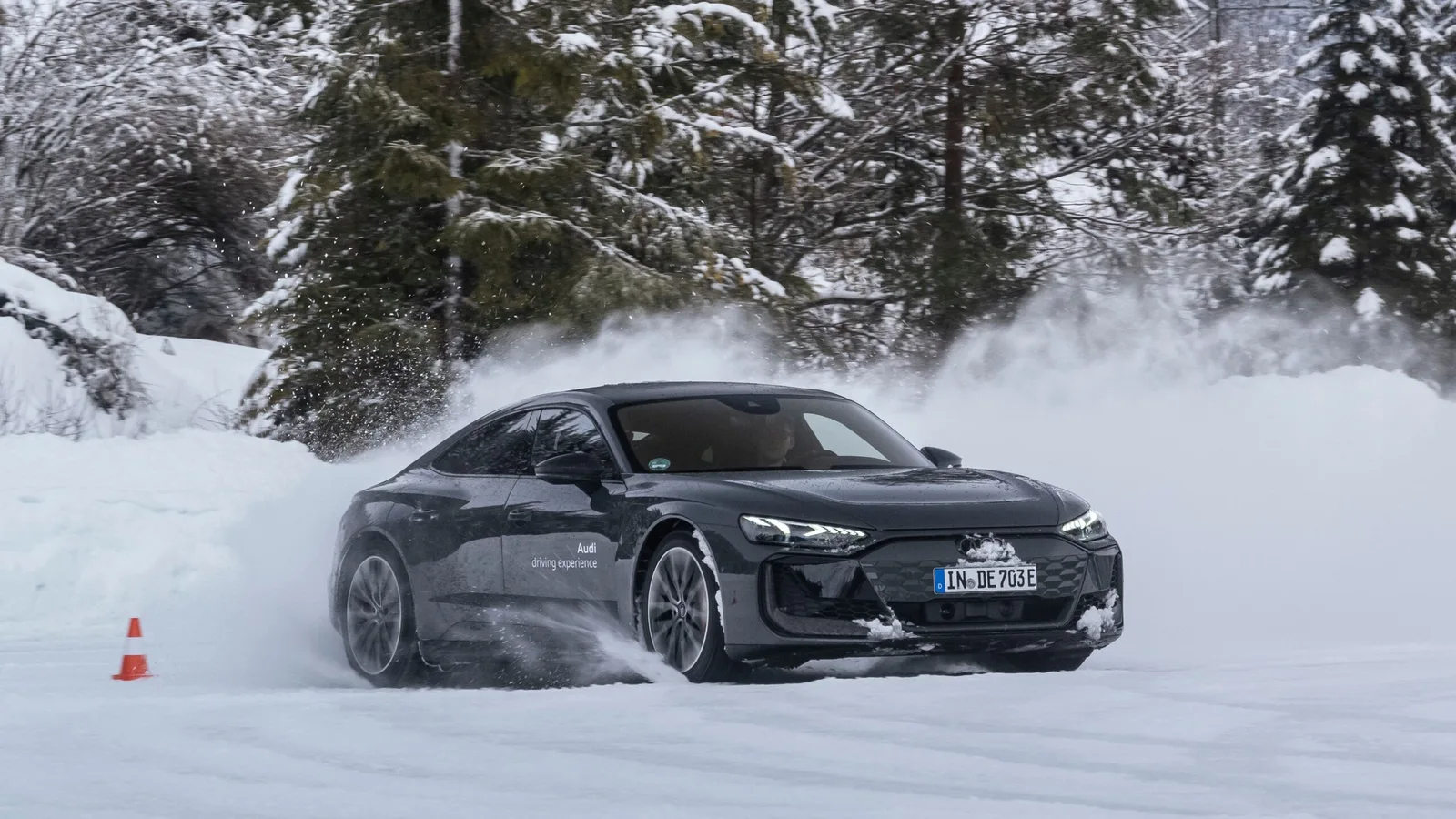
Picture this. You’re given the key fob to the most powerful production Audi ever built, with 912 electron-fueled horsepower at your disposal. Where would you choose to drive it? A winding mountain road? What about a racetrack? Or perhaps even a drag strip where you can exploit a 2.4-second 0-60 mph sprint? You almost certainly didn’t think, « I’d love to drive this on a frozen field in the Austrian Alps. » Yet the latter is where Audi gave me a first taste of the newly updated version of the Audi RS e-tron GT; a surface with a friction coefficient of between 0.05 and 0.2 (dry asphalt measures about 0.8). It doesn’t take a rocket scientist to realize that’s not the environment you want to be in to deploy 912 horsepower, so why would Audi give us our first chance to drive its new electric hot rod in arguably the worst possible conditions for such a vehicle?
2025 Audi RS e-Tron GT
Base MSRP
$167,000
Base Trim Engine
electric
Base Trim Transmission
2-Speed Automatic
Base Trim Horsepower
912 hp
0-60 MPH
2.4 seconds
Top Speed
155 mph
Expand
This wasn’t your typical first drive. That will come later this year on US soil, and you can bet CarBuzz will be there. No, this was a drive of a different sort, meant to showcase how a new generation of Audi’s quattro all-wheel drive system behaves in the most extreme circumstances imaginable; all-wheel drive with no mechanical connection between the front and rear axles. For that reason, Audi took me to within a stone’s throw away from where it first showcased the virtues of AWD to executives and dealers and set me loose on the Audi Driving Experience.
The costs of this trip were borne entirely by Audi USA, who flew me out to Germany, chauffeured me to the town of Seefeld in Austria, put me up in a hotel for two nights, and provided free access to the Audi Driving Experience for a day. All impressions are my own, and this article is not part of any paid-for promotion.
Dancing On Ice Showcases An Entirely Different Side Of The RS e-tron GT
In a nutshell, the Audi Driving Experience is the German marque’s advanced driving academy, with branches all over the world. The particular setup I experienced is only operational for two months of the year, in January and February, when daytime temperatures in Seefeld, Austria are at or below freezing and snow flurries are an almost hourly occurrence. Here, you don’t learn to clip apexes and nail your trail braking on track. Instead, you’re taught how to regain control of a car in conditions with zero grip and how to lean on various techniques to prevent the worst from happening. With stability control disengaged, and 912 hp deployed through studded tires (3mm studs), this was an opportunity to experience the RS e-tron GT’s chassis in its rawest form – and, importantly, to understand how electronic AWD (e-AWD) systems operate in driving conditions you never want to encounter on your regular commute.
Instead of avoiding those conditions, I was voluntarily thrust into a series of exercises designed to exploit the lack of grip for the sake of education, with rally veteran and head instructor at the Audi Driving Experience, Stefan Eichhorner, on hand to give me pointers as I went. Throughout the day, I partook in a lineup of challenges that most casual autocross drivers would balk at: cone slaloms, donut exercises, and short courses not unlike you’d encounter at an SCCA Autocross event anywhere in the US.
The difference is the surface, with a prepared ice field diminishing traction to near non-existent levels. With stability control disengaged, breathing on the throttle can easily light up all four studded tires. I’ve spent many hours cursing cone placement at local autocross events and consider myself somewhat experienced at this type of driving.
Tobias Sagmeister/Audi
But on ice, things are different. You don’t steer with the wheel so much as you do with the throttle and brakes, and an entry speed 2 mph higher than it should be, can easily see you overshoot your turning point at risk of crashing into the nearest snowdrift.
But in these less-than-ideal circumstances, the RS e-tron GT revealed some interesting characteristics.
Throttle Mapping On An EV Doesn’t Need To Be An On-Off Switch
Unlike a combustion engine, which has to overcome mechanical inertia and reach a certain rev threshold before it can deploy maximum power, electric motors are often characterized as being able to deliver all their power from zero rpm with an on-off switch-like behavior. The zero rpm thing is a bit of a misnomer, as nothing generates power at rest, but the on-off switch has always been somewhat of a concern for me. While I like the concept of deploying lots of power all at once, in the hands of an untrained driver, even 600 hp being deployed all at once is incredibly risky. We’ve all seen the now infamous Lotus Evija X crash at the Goodwood Festival of Speed last year, and that was with a pro racing driver at the helm.
Related
Weird Things Your Car Does In Winter That Are Actually Normal
Cold car quirks: what’s actually normal from your ride when the mercury drops?
A powertrain switching on and off with immediate effect may sound great, but in zero-grip conditions, both of those things are a bad idea. Too much power deployed all at once would break traction, and if the motors retarded rotation the moment you backed off the throttle, you’d all too easily lock up and become a complete passenger heading straight for your nearest streetlight.
The RS e-tron GT’s powertrain doesn’t fall foul of either of these mistakes. You’d think nearly a thousand horsepower on ice would result in the complete inability to find any traction at all, but to initiate oversteer in the RS e-tron GT, you need a heavy prod of the throttle to be sustained for more than just the blink of an eye. Audi has tuned in a ramp-up in power delivery that feels far more like a traditional gas-powered performance sedan, and when you come off the throttle, the powertrain assumes a state of neutrality rather than one that slows the wheels too aggressively – at least in the standard regen setting.
EVs have never truly treated the throttle like an on-off switch; it’s always been more of a dimmer-like control. But in the RS e-tron GT, the modulation feels incredibly natural, allowing tiny adjustments without upsetting the proverbial apple cart. It feels natural, as it unsurprisingly should, but what surprised me more wasn’t what I felt inside the car but what I witnessed from outside of it.
The Infinite Adjustability Of Electronic All-Wheel Drive
The way an AWD system is configured is one of the biggest differences between combustion and electric Audis. In a combustion model, there’s a physical connection from front to rear with one power source providing a singular input. Sure, the torque split may be varied using differentials and clutch packs, but how each axle behaves can be directly correlated to what the other is doing. At its root, power delivery is purely determined by what the engine is doing.
But in a dual-motor EV like the RS e-tron GT, there is no physical connection from front to rear. Each axle has a separate motor, operating independently. It’s like having two engines in a car instead of one. EVs are typically considered less complex in the powertrain department, but when it comes to icy situations with next to no grip, the complexity is dialed up to 11.
From behind the wheel, you wouldn’t say so, though. Point the wheel where you want the car to go and balance the throttle accordingly, and the RS e-tron GT settles into a natural flow state in which I felt like I could do donuts for hours on end. Coincidentally, the day I was doing my icy donuts, Porsche announced a new ice drifting record in this car’s mechanical sibling, the Taycan. Not taking anything away from the driver at the helm of the Porsche, but I felt like the Audi was so easy to balance that I could’ve challenged that record myself. I know better than that, but the RS e-tron GT makes things like donuts feel easy.
Between stints behind the wheel, I stood on the fringes of the ice field (or in the middle of the exercise to film some of the footage you see above and below) watching my industry colleagues doing donuts of their own and noticed something curious. At times, the front axle of the RS e-tron GT seemed to stall out, the outer front wheel ceasing rotation despite the car continuing flawlessly on its arc around me. Whereas a combustion-powered, AWD Audi would keep all four wheels lit to some extent, spinning them faster on the gas, the RS e-tron GT’s e-AWD behaves differently. It achieves balance through careful modulation of both e-motors, the chassis combining feedback from a variety of pitch and yaw sensors, and throttle input sensors, and processing them through complex algorithms to determine exactly when and how much each motor needs to deploy its power.
This adjustability is one of the unsung benefits of electric powertrains, adding a layer of adjustability combustion engines can’t match. The variability is so great that it even impacts development times of cars like the RS e-tron GT. In attendance, Audi e-tron GT project manager and chassis engineer Dr. Jaan Mattes Reiling was able to answer some questions I had about the development of such an EV. He explained that while the overall development time is about the same as an ICE Audi of yesteryear might have been, his team has to spend significantly more time programming the chassis to account for the millions of scenarios you may encounter, ensuring the front and rear of the car never feel out of sync.
How The RS e-tron GT Feels More Audi And Less Porsche
Dr. Reiling, or Mattes as he insisted we called him, also explained how Audi differentiates a platform-engineered car like the RS e-tron GT to feel more like an Audi than a Porsche.
The key changes are in the car’s name, as the e-tron GT family is meant to feel like a true grand tourer, capable of crushing continents at speed without being overwhelming to drive. As such, the RS e-tron GT is softer than the Taycan in key areas, notably in the default suspension setting where there’s a little more give to the adaptive air suspension. The steering effort is also reduced, affording the range-topping EV a more laidback feel.
« It’s not about making it better or worse than Taycan, it’s about making it feel like the Audi product our customers expect. »
– Dr. Jaan Mattes Reiling, Audi e-tron GT Project Manager
The process of arriving at this point isn’t quick, either. It’s not just a case of « let’s make it softer » and off we go for Audi. Providing a brief glimpse into the development of Audi chassis, Mattes speaks of the spreadsheets with dozens of metrics on which each car is tested, with scoring of both subjective and objective measures. The objective measures include torque required to achieve certain steering angles, or angles of lock to achieve a certain turning radius, among many others. The subjective measures are arguably more difficult to quantify, though, as they rely on the feedback of a plethora of engineers and test drivers, all of whom have to put themselves in the mindset of an Audi buyer while developing a car.
Related
2025 Audi RS e-tron GT Is Barely Slower But Much Cheaper Than Taycan Turbo
The latest version of the Audi RS e-tron GT makes more than 900 hp, becoming the quickest-accelerating Audi ever.
German engineers are often criticized for being overly committed to objective data, with the jokes hinging on a stereotypical lack of humor associated with German engineering culture. You can imagine a Mercedes-AMG engineer telling you how the four-cylinder hybrid in the new AMG C63 is objectively better in every way, but for fans of the AMG brand, we just want the old V8 noise we know and love. But Mattes admits that objective traits sometimes need to take a backseat to subjective feel, telling us that there have been several occasions when Audi made cars feel better at the expense of what the data said.
When Subjective Feedback Matters More Than Objective Data
The best example of this when it came to the RS e-tron GT’s development cycle was in the tuning of its adaptive suspension, replete with active anti-roll technology. In theory, the system can completely eliminate body roll when cornering, keeping the car perfectly flat through single turns or even slaloms with punishing left-right weight transfers. Technically, this means the car grips better, maintaining an ideal contact patch at all four corners no matter where you are in a corner. But Audi’s chassis development team couldn’t stand how unnatural this felt. Objectively, it’s better, but subjectively, having body roll is an integral part of how a driver perceives the limits of a car’s handling. Feeling a car lean through a corner is the best way to tell how quickly you’re reaching the limits of grip, and when you do eventually reach the limits of mechanical grip, you’re expecting it.
This was brilliantly displayed while driving the RS e-tron GT on ice in both Comfort and Dynamic driving modes. Converse to what its name suggests, Comfort was the better mode for having fun sliding around, as you can use the weight transfer afforded by the cushier suspension tune to load and unload the front axle at will. Learning how to perform the Scandinavian Flick was far easier in Comfort than Dynamic. Contrarily, when I was sent out at the end of the day to complete a timed lap around the iced-over autocross circuit, Dynamic kept things in line more, allowing me to set a quicker time.
An Experience Everyone Should Indulge In
From the perspective of delivering a first impression of the facelifted 2025 RS e-tron GT, this experience didn’t yield much. For that, you’ll have to wait for a true First Drive in American conditions a little later this year. But participating in the Audi Driving Experience taught me a heckuva lot about Audi’s most powerful production car in ways I didn’t anticipate, showcasing the benefits of an electric powertrain in conditions far beyond what most ordinary drivers will experience.
Car aside, the Audi Driving Experience is also something I can’t recommend highly enough. The exercises I got to participate in form part of a two-day experience anyone can attend, and the lessons learned are vital for making the public better drivers as we head into an era where four-figure horsepower outputs will soon become the norm.
From teaching advanced car control and recovery techniques to simply showcasing how a car feels on ice in different driving modes, if every driver on the roads took part in a course like this, the roads would be a much safer place.
I’ll be back next year on my own dime. And maybe again the year after that, too. An experience like this is proof that you don’t need to be doing hot laps on dry tarmac to a V8 soundtrack to have fun.
\